












LLM Comparison: Text, Code & AI Models 2025 Explained
In the world of Artificial Intelligence, Large Language Models (LLMs) are a central building block. They generate text, code, analyses, and dialogues – and differ significantly in strengths, usage, and license. In this article, you will find an up-to-date comparison of LLMs, important providers, usage scenarios, and concrete tips on how you can get started with a few experiments.
Artemis (Tetris Clone)

DIVION – Astro Edition
Zeichne Grenzen, decke Weltraumfotos frei. 25 Level, Sound von nuonu, Bilder der Sternenfreunde Wurmannsquick.
What are LLMs? – Fundamentals
A Large Language Model (LLM) is trained on vast text and code datasets. It learns relationships between words, syntax, and concepts, and can therefore generate new content, answer questions, write code, or analyze existing texts.
Origin & Architecture
- Data Collection & Preprocessing – Texts, forums, scientific publications, code repositories are collected and cleaned.
- Training & Fine-tuning – The model learns probabilities, common patterns, logical structures; followed by fine-tuning and safety layers (e.g., RLHF).
- Evaluation & Deployment – Tests on benchmarks, control of biases and hallucinations; deployment via cloud, API, or locally.
How to Use LLMs? Online, Locally & via API
Online / Cloud
You use a model via web services or platforms. Advantage: latest versions, easy to use. Disadvantage: potential data privacy issues, dependence on the provider.
Offline / Local
The model runs on your own system. Advantage: maximum control, data privacy, lower latency. Disadvantage: hardware requirements and setup. Projects like OpenAI gpt-oss enable models with open weights to be run locally for the first time.
Via API / Integration
With APIs, you can integrate AI functions into your own tools, apps, or backends. This is ideal for automation, agents, or customized workflows.
LLMs vs. Traditional Systems (Search Engines, Encyclopedias)
Search engines provide existing content and links to sources. An LLM generates new answers based on its learned knowledge – with the risk of errors (hallucinations). Therefore: always critically review, possibly working with source references, for example.
Innovations & Trends 2025 in the LLM Sector
- GPT-4.5 & GPT-4.1 from OpenAI: improved text quality, stronger context understanding, and more creative answers. (OpenAI GPT-4.5)
- Open-Weight Models (gpt-oss): OpenAI models with open weights that can be run locally for the first time. (Source article: Wired on Open-Weight Release)
- Advanced Capabilities in Claude: Claude can now create and edit files (Excel, DOCX, PDF) and use external tools. (Anthropic News: Claude Creates Files, Tool Use in Claude)
- Multimodality: Models like GPT-4 accept text & images as input. (OpenAI GPT-4 Research)
- Hybrid / Novel Architectures: Models like Falcon-H1 combine efficiency with long-context capability.
- Regional / Domain-Specific Models: Smaller, specialized LLMs for medicine, law, local language, etc., are becoming more actively available.
Use Cases: Where LLMs are Effectively Used Today
- Text & Content Creation: Blog posts, product descriptions, marketing variations, newsletters.
- Programming Assistance & Code Generation: Snippets, refactoring, tests, documentation, debugging.
- Summaries & Analysis: Structuring large texts, extracting key statements, organizing topics.
- Research & Idea Generation: Questions, approaches, contextual input.
- Dialogue Systems / Virtual Assistants: Chatbots, support agents, meeting assistants.
- Localization & Translation: context-appropriate translations, culturally adapted versions.
- Specialized Assistance: Contracts, legal, medical – with human review.
- Automation & Agents: Workflows, APIs, batch jobs, multi-step processes.
Selected Providers & Models in Comparison
Note: This selection is exemplary and should help you discover offerings – not as a final recommendation.
OpenAI / GPT Family
OpenAI offers a wide range of capabilities with GPT-4 and newer variants — including multimodality, API access, and integrations. (OpenAI Homepage)
API documentation here: OpenAI GPT API Docs
Anthropic / Claude
Claude places great emphasis on safety, tool integration, and user-friendliness. Newer versions support file operations and tool access. (Claude at Anthropic)
More about Claude for Business: Claude for Work
Meta / LLaMA & Open-Source Models
Meta regularly releases new versions of LLaMA (e.g., LLaMA 4) as an open-source model for local use and customization.
Mistral, DeepSeek & Specialized Models
Mistral offers efficient models with open-weight variants. DeepSeek (e.g., DeepSeek-R1 / V-series) focuses on reasoning. Specialized domain models (medicine, law, language) are gaining importance.
Falcon Models & Hybrid Approaches
Projects like Falcon-H1 demonstrate new architectural approaches that combine efficiency and context retention.
How to Find Your Ideal LLM – Checklist
- What do you want to achieve? (Text, code, analysis, agents…)
- What context scope / input complexity?
- Multimodality needed (image / audio)?
- Data privacy / local vs. cloud?
- Open-source vs. proprietary / licensing costs?
- Quality requirements vs. creativity?
- Technical integration (API / tooling)?
Incentive: Test Yourself & Learn
Many providers offer free trials or limited free usage. Start with small projects (e.g., blog text, prompt test, code script), compare results, and find your ideal model for your application.
Further Resources:
Examples of Generative AI in Text and Code
Text Generation & Automation: Whether blog articles, creative stories, song lyrics, or business emails – AI models can efficiently write content in various styles. They are suitable for content marketing, editorial work, and social media. Especially in customer service, AI-generated responses are used to automatically process inquiries and optimize FAQs.
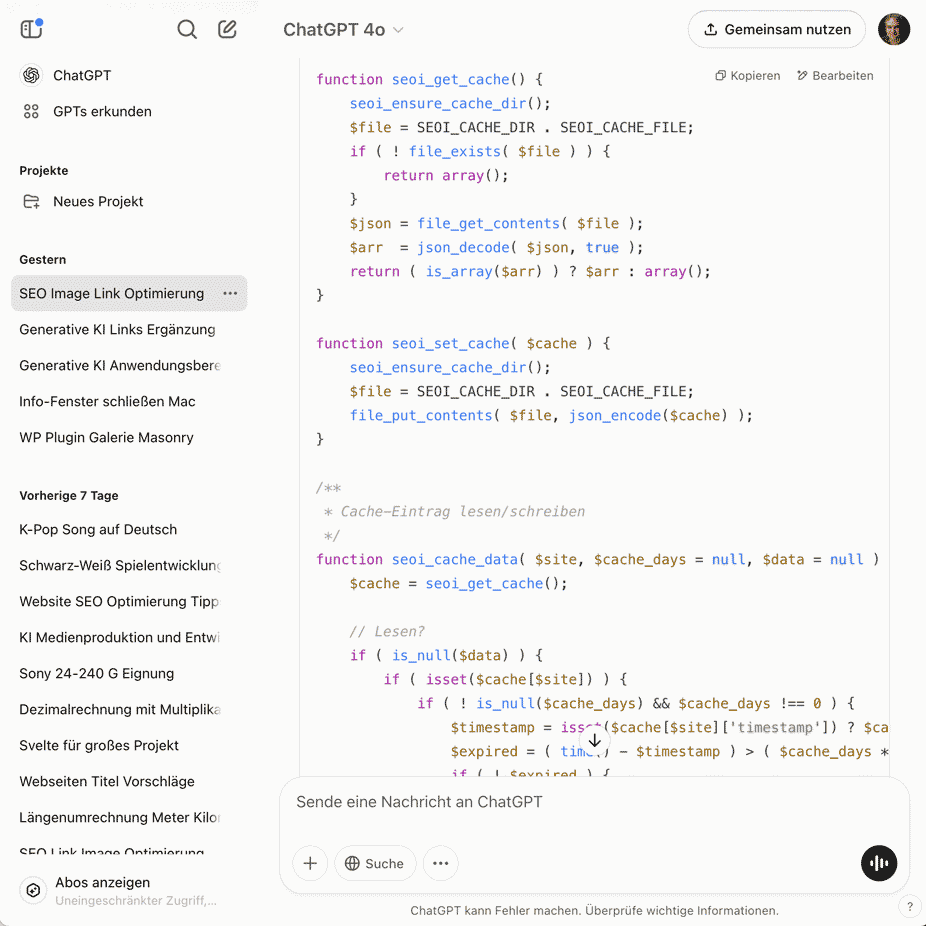
Code Generation & Software Development: AI can help write complex algorithms, find errors, or directly generate functional code for web applications and plugins. Developers can use AI-powered suggestions for optimized and more efficient code snippets. Especially in app and game development, AI can automate repetitive tasks, leaving more time for creative processes.
Data Analysis & Information Processing: In addition to writing, AI can also analyze, structure, and evaluate huge amounts of data – from tables to scientific texts and technical documentation. Companies use AI for market analysis to predict trends or optimize financial reports. Researchers deploy AI models to perform complex statistical evaluations or discover correlations in large datasets.
Automated Translations & Language Processing: Language models are revolutionizing the field of automated translations. Modern AI systems can not only translate simple texts but also consider cultural and contextual aspects. This is particularly useful in international companies, for content localization, or for accessible communication.
Virtual Assistants & Dialogue Systems: Chatbots and voice assistants like ChatGPT are now established in many areas. They help not only in customer service but also in internal corporate communication. AI-powered assistants can log meetings, manage calendars, or support creative brainstorming sessions.
Automatic Summaries & Text Analysis: AI can transform long texts or articles into short, understandable summaries. This facilitates information intake in newsrooms, scientific papers, or legal documents. Especially in research and the legal field, the ability to automatically highlight relevant passages is a huge time-saver.
Personalization & Recommendation Systems: Generative AI plays a crucial role in personalizing text content. News services or online platforms adapt articles, advertisements, and notifications individually to reader interests. Companies use AI to create personalized product descriptions or marketing texts.
Law & Contract Management: Law firms and companies use AI for contract analysis and creation. AI can identify clauses, assess legal risks, or automatically adapt contracts to existing laws. This saves time and reduces the risk of human error.
These examples show that generative AI plays an increasingly important role not only in creative fields but also in numerous economic and scientific sectors. Due to the continuous development of these technologies, their influence will continue to grow in the future.
ChatGPT Screenshot
AI Text & Code Providers and LLMs at a Glance
OpenAI
OpenAI offers GPT-4 (8k/32k), a highly advanced language model characterized by excellent performance in complex tasks and an extended understanding of context.
As a closed-source solution, however, the model is subject to commercial licensing terms, which restricts free use. Furthermore, training is based on data up to September 2021.
More info: OpenAI
o1 (incl. o1.ai)
The o1 group provides LLMs available in various versions – from models at PhD level to compact, inexpensive versions and efficient high-performance variants.
This enables use in diverse scenarios, always prioritizing high performance and efficiency. However, as closed-source products, these models are not freely available, which should be considered for free use.
More info: o1
o3
The o3 series focuses on advanced reasoning and coding capabilities. With offerings that include both powerful and compact variants (such as o3, o3 mini, and o3‑mini), o3 appeals to users who need flexible solutions for demanding applications.
However, the closed source code limits open access and free further development, which is considered a disadvantage.
More info: o3
With Gemini 1.5 Pro, Google delivers a multimodal LLM capable of processing textual and visual information. Deep integration into Google's infrastructure and versatile application possibilities offer clear advantages.
However, as a closed-source model, Gemini is limited in free use and often tied to commercial terms.
More info: Google AI
Anthropic
Anthropic relies on high performance with Claude 3.5 Sonnet, reflected in strong benchmark results. Special emphasis is placed on safety and ethically justifiable answers.
However, its closed-source nature restricts transparent access and can lead to paid usage models.
More info: Anthropic
DeepSeek
DeepSeek impresses with its open-source solutions (DeepSeek‑R1 and DeepSeek‑V3), based on an innovative MoE architecture and offering outstanding reasoning capabilities – for instance, in processing Chinese content and mathematical tasks.
The open source code allows for customization and free access, although certain versions (like DeepSeek‑V3) may come with usage restrictions.
More info: DeepSeek
Grok by xAI
Elon Musk's xAI introduces Grok‑2, a powerful LLM that can even surpass GPT‑4 in some metrics. This model is aimed at users seeking maximum performance in specialized applications. In mid-February 2025, Grok-3 was unveiled, with ambitions to become one of the best LLMs on the market.
More info: Grok
Meta
With LLaMA 3.2, Meta offers an open-source solution characterized by improved reasoning and coding capabilities. Its free availability allows developers to adapt the model and integrate it into various applications.
However, productive use requires technical expertise and appropriate infrastructure.
More info: Meta AI
Mistral AI
Mistral AI impresses with Mixtral 8x7B, an open-source model that operates resource-efficiently thanks to an efficient MoE architecture. This model offers a flexible and cost-effective solution, although its comparatively smaller model size may also entail limitations in certain application scenarios.
More info: Mistral AI
Hugging Face
Hugging Face is not an LLM, but a platform that provides a variety of open-source LLMs and tools for their development and use. It offers access to models like BERT, RoBERTa, and many others developed by the community.
More info: Hugging Face
Cohere
Cohere offers a range of LLMs for various applications, including text generation, summarization, and semantic search. Their models are accessible via an API and can be integrated into different applications.
More info: Cohere
Amazon Web Services (AWS)
AWS offers Amazon Bedrock, a platform that provides access to various third-party LLMs (such as Anthropic, AI21 Labs, and Stability AI) as well as its own models (such as Amazon Titan).
More info: Amazon Bedrock